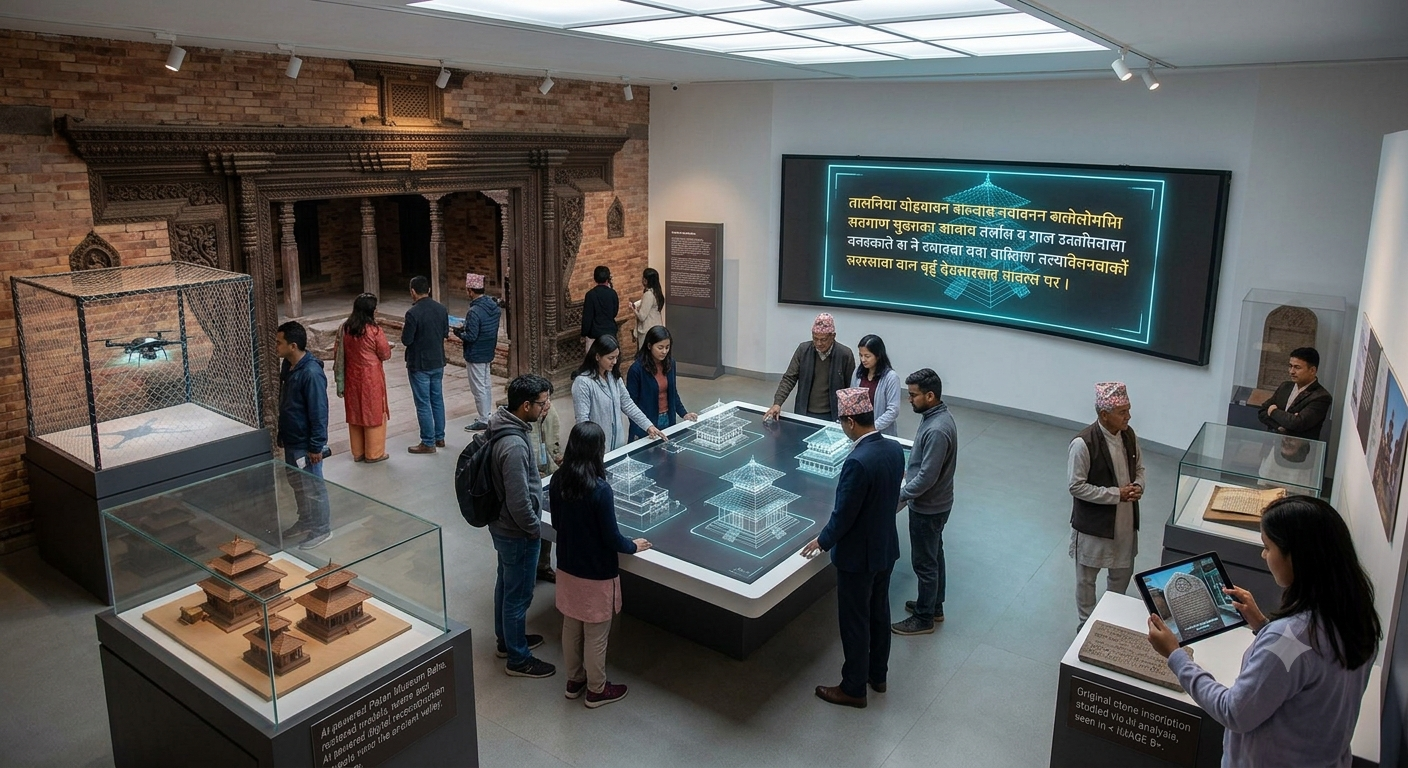
When most people think of Newar history, their minds instantly go to the breathtaking temples, palaces, and monuments of the Kathmandu Valley. But the true story of the Newar people extends far beyond these brick and wood structures. For centuries, they were the architects of Nepal’s broader cultural and economic landscape, making profound contributions through trade, art, education, literature, and governance.
However, much of this rich narrative remains hidden in the shadows of time. Today, modern technology—specifically Artificial Intelligence (AI)—is emerging as a powerful tool to bring these untold stories into the light.
The Fading Chapters of History
Historically, Newar merchants and artisans were the economic engines of the region, building vast and successful trade networks that stretched into Tibet, India, Bhutan, and across other parts of Nepal. They brought back not just wealth, but new ideas, technologies, and cultural exchanges.
Yet, history is rarely a straight line. Over time, shifting political landscapes altered the roles of Newar nobles, merchants, and local institutions. At various points in history, national policies aimed at creating a single, unified language and identity inadvertently marginalized local cultures. The public use of Nepal Bhasa was discouraged, and many traditional Newar cultural institutions were weakened.
Because of this, many records, personal accounts, and trade documents were lost, damaged, or simply forgotten. Historians and archaeologists are still working tirelessly to piece together how these massive societal shifts impacted Newar heritage.
Enter the "Digital Archaeologist"
This is where Artificial Intelligence steps in. While AI is often associated with the future, it is proving to be one of our greatest assets for understanding the past. AI acts as a high-speed research assistant, capable of doing things that would take humans lifetimes to achieve on their own.
Here is how technology is helping uncover Nepal's hidden past:
Translating Ancient Texts: AI-powered language models can learn to read classical scripts like Ranjana or Prachalit. They can rapidly scan and translate ancient manuscripts, even when the languages are no longer widely spoken.
Restoring Faded Documents: Machine learning algorithms can analyze faded, torn, or water-damaged manuscripts and digitally reconstruct the missing ink, allowing researchers to read documents that were previously considered ruined.
Rebuilding History in 3D: Using thousands of old photographs and modern drone footage, AI can create highly accurate 3D digital models of historical sites, palaces, and trade routes that have been altered or destroyed over time.
Preserving Oral Histories: Some of the most valuable history is held in the memories of community elders. AI tools can quickly transcribe and categorize hundreds of hours of recorded audio, ensuring that aging oral traditions and dialects are permanently archived and easily searchable.
The Human-Technology Partnership
As powerful as these tools are, AI cannot replace the historian. Technology does not understand context, human emotion, or cultural nuance. It is simply a tool that processes massive amounts of data with incredible speed.
If an AI translates an old trade document, a human historian must still evaluate what that document meant to the people of that era. If AI builds a 3D model of an ancient courtyard, an archaeologist must verify its historical accuracy. The final conclusions must always be grounded in critical thinking, reliable evidence, and careful human research.
A Brighter View of the Past
By bringing together computer science, history, archaeology, linguistics, and local community knowledge, Nepal has a unique opportunity. We can move past a narrow view of history and uncover a much richer, more diverse picture of our shared past.
Using AI to rescue the untold stories of the Newar people—and all of Nepal’s diverse communities—ensures that our heritage is not just preserved in museums, but kept alive and accessible for future generations.