When most people think of history, they picture old textbooks, famous kings, and grand monuments. But true history is much richer than that. It is made of the everyday choices, personal struggles, regional trade routes, and spoken stories of ordinary people across generations.
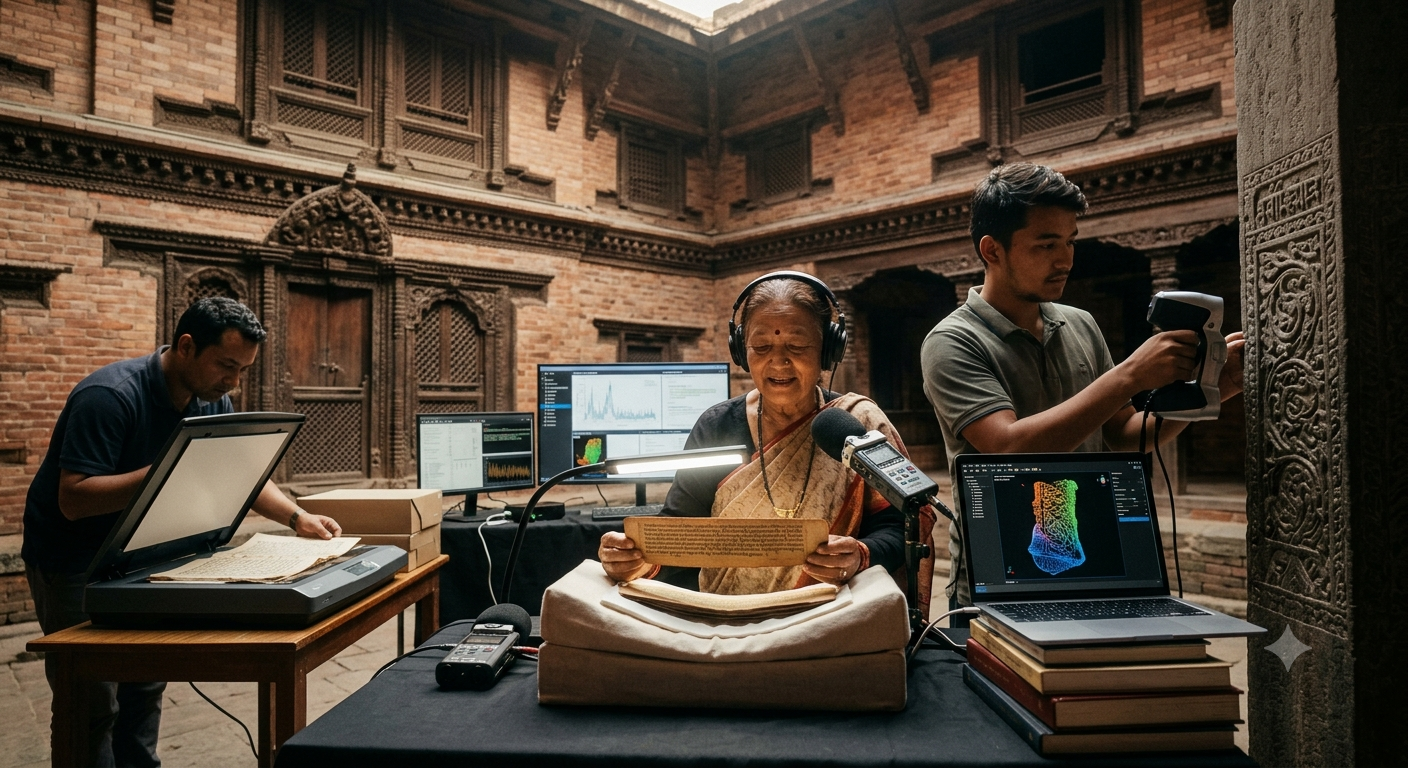
In Nepal, a new wave of research is taking shape. By combining traditional field research with Artificial Intelligence (AI) and oral history recording, researchers are making remarkable discoveries about the country's heritage—starting with the rich past of the Kathmandu Valley and the Newar community.
1. The Heritage of the Newars and the Himalayan Trade Routes
The Newars are among the earliest town-dwellers of Nepal, and their influence on the nation's culture is undeniable. Centuries ago, they turned the Kathmandu Valley into a vibrant hub of art, architecture, and learning. Long before the Malla kings expanded the valley’s famous palaces and temples, Newar merchants were already establishing daring trade routes across the harsh terrain of the Himalayas.
What Made This Trade So Important? Merchants carried silk, wool, salt, metals, spices, and finely crafted items back and forth across mountain passes. Wealth generated from trade supported local education, art, building construction, and religious traditions. The valley became a meeting point where ideas, literature, and art from India, Tibet, and Central Asia blended naturally.
2. Asking the Tough Questions About History
Celebrating magnificent buildings and art is important, but true historical research also requires asking difficult, uncomfortable questions. Understanding what happened behind the scenes gives us a complete picture of how society evolved:
-
How did shifts in power over different eras change the everyday lives, language, and trade of the Newar community?
-
What happened to sacred manuscripts, family archives, and stone inscriptions during periods of war or political change?
-
Which stories were preserved, and which were forgotten or altered?
-
Beyond the lives of rulers, what were the economic realities and social movements experienced by farmers, local scholars, and craftsmen?
To answer these questions, historians cannot rely on rumors or guesses. They need concrete proof—such as physical ruins, ancient handwriting, family diaries, and personal oral testimonies.
3. How AI Helps Researchers Work Faster and Smarter
Old manuscripts written on fragile palm leaves or handmade paper can easily rot, tear, or fade. Stone inscriptions worn down by centuries of rain become nearly impossible to read. This is where modern technology comes in.
Artificial Intelligence provides smart tools that help scholars protect and make sense of these endangered materials:
-
Computer vision enhances faint lines on worn stone or metal plates so they can be read clearly.
-
Machine learning models convert rare scripts into typed text and translate them into modern languages.
-
Pattern recognition allows AI to scan thousands of pages in minutes to spot names, dates, and trade patterns across centuries.
-
3D scanning technology builds detailed digital models of damaged temples and monuments.
Note: AI is an assistant, not a replacement for human judgment. Experts—historians, archaeologists, and linguists—are still essential to analyze the context and verify whether the data is accurate.
4. Gathering Spoken Stories Before They Disappear
While paper and stone give us official records, oral history gives us the human spirit. Elders in every community hold personal memories, local legends, family histories, and traditional wisdom that were never written down in official books.
Collecting these spoken stories requires a careful, respectful process—starting with researching the period and local context beforehand so researchers can ask thoughtful, open-ended questions.
The Ultimate Goal: A Fair and Truthful Legacy
The purpose of studying history isn't to create arguments or prove one group superior to another. Its true purpose is to seek truth based on real evidence, encourage open discussions, and build a complete national picture that respects every community's contributions.
By combining cutting-edge tools like AI with the warmth of human interviews and rigorous research, Nepal has an extraordinary opportunity to save its endangered records, uncover forgotten stories, and pass down an honest, rich heritage to future generations.