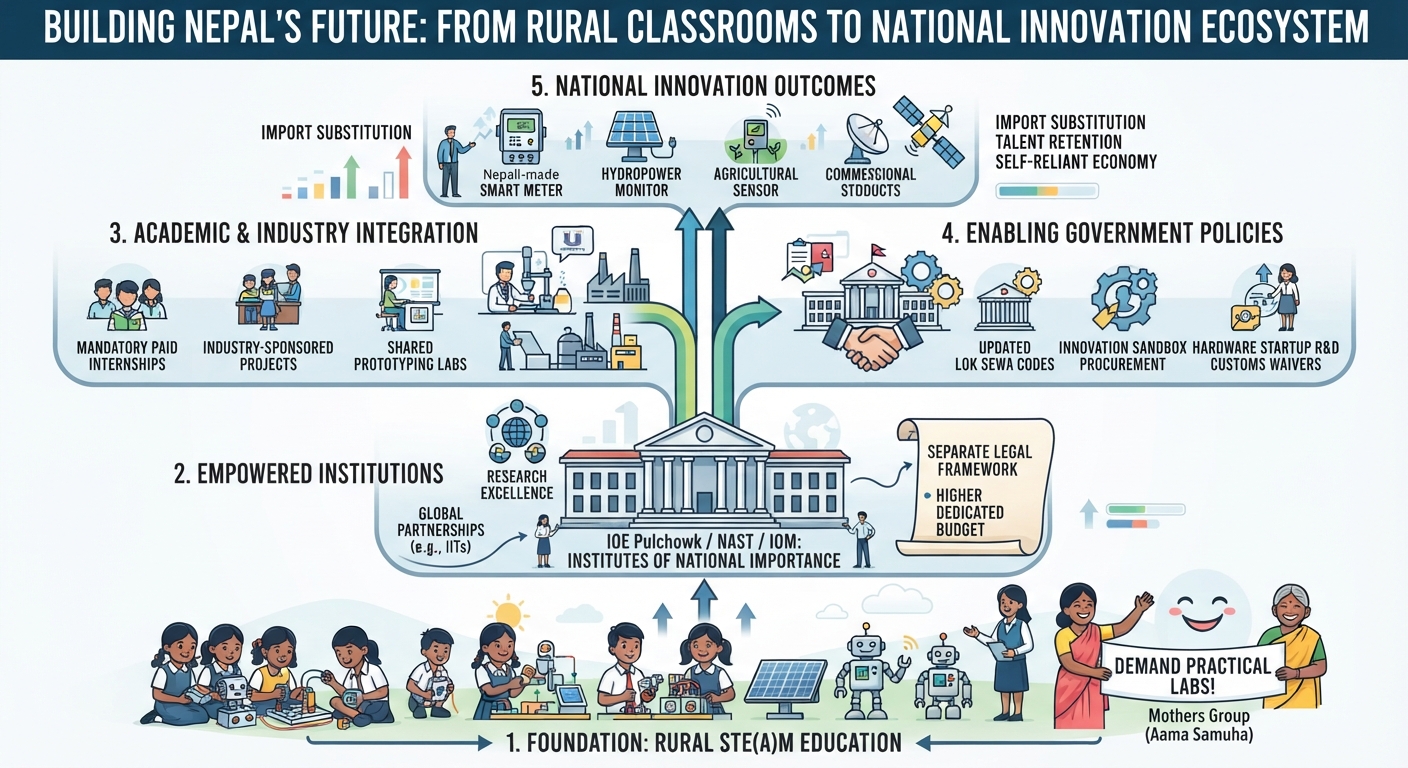
In the age of Artificial Intelligence (AI), electronics engineering has become more important than ever. AI cannot work on its own—it needs physical sensors, chips, and machines to see, measure, and act in the real world.
Yet in Nepal, many bright young students finish their Electronics Engineering degrees only to struggle for jobs or leave the country. This is not because Nepal does not need engineers. It is because our schools, communities, colleges, government offices, and industries are not working together—and our top universities lack the freedom and funding they need to lead national innovation.
1. Start at Rural Schools with STE(A)M—Led by Mothers’ Groups
If we want a strong group of electronics engineers in Nepal, we cannot wait until college. The Ministry of Education must bring practical STE(A)M (Science, Technology, Engineering, Arts, and Mathematics) learning directly into rural school classrooms for young children. Adding Arts alongside science and engineering helps children build creativity, design sense, and problem-solving skills—things that AI cannot easily replace.
Right now, STE(A)M in Nepal mostly exists only in government papers. Real practice in village schools is very weak. To make it real:
Mobilize Rural Mothers’ Groups (Aama Samuha): Mothers’ groups are one of the strongest social forces in rural Nepal. They must come forward to demand awareness campaigns, ask local municipalities (Palikas) and school boards why practical labs are missing, and make sure both daughters and sons get equal chances to learn electronics and technology.
Move Beyond Book Memorization: Students in Grades 6 to 10 should spend time every week building simple circuits, small solar lights, or water-level alarms, rather than just memorizing textbook pictures for exams.
Train School Teachers: Giving a school a box of equipment does not work if teachers do not know how to use it. Engineering colleges should train village science teachers and send senior college students to help mentor children in rural schools.
Use Low-Cost Local Kits: Schools do not need expensive foreign robot kits. Simple, low-cost electronics kits made in Nepal can help rural schools learn how technology works from a young age.
2. Declare Premier Institutions as Institutes of National Importance
Even the brightest rural and urban students cannot reach their full potential if our top universities remain trapped in slow bureaucracy and low budgets.
Parliament must pass a law declaring Nepal’s premier academic and research institutions—such as the Institute of Engineering (IOE), the Institute of Medicine (IOM), and the Nepal Academy of Science and Technology (NAST)—as Institutes of National Importance with a separate legal framework and a separate, much higher national budget.
Freedom to Innovate: A separate legal status frees top institutions from political interference and slow administrative rules so they can quickly update courses, hire top researchers, and partner with global universities like the Indian Institutes of Technology (IITs).
Dedicated Research Funding: With a separate higher budget, these institutions can build modern research centers for AI, robotics, drones, medical devices, and chip design, while also funding local research labs across provincial colleges, schools, and hospitals.
Mobilizing Talent for Nepal: By giving top researchers and students world-class labs and fair support at home, Nepal can stop brain drain and mobilize its best minds to solve national problems.
3. Why Nepal Needs Electronics Engineers Today
For many years, people thought electronics engineers could only work in telephone companies. Today, almost every part of Nepal’s development needs their skills:
Hydropower and Electricity: Hydropower plants and power lines need smart meters and automatic control systems made for Nepal.
Disaster Safety: Our hills and rivers need early-warning sensors for landslides and floods, plus drones to check damage after disasters.
Clean Energy and Electric Vehicles: Electric cars and solar systems need locally designed battery managers and charging controllers.
Farming and Village Healthcare: Farmers need low-cost soil sensors and automatic watering systems, while rural health posts need portable medical testing tools.
Global Tech Jobs from Home: With training in chip design and smart devices, Nepali graduates can stay in Nepal and do high-paying engineering work for international tech companies.
4. Four Practical Steps to Fix College Education and Jobs
Alongside granting national-importance status to premier institutions, four urgent changes are needed across engineering education and industry:
Teach Through Real Projects: Colleges must move away from exam-only grading. Every final-year student should complete a paid, six-month internship in a real company and build a useful product—like a water-quality monitor or hydropower sensor.
Build Shared Research Labs and Regional Partnerships: Instead of small, unused labs in every college, Nepal should build shared prototyping and testing labs linked with regional partners like the IITs for joint research and teacher exchanges.
Update Government Hiring and Buying Rules: Outdated rules at the Public Service Commission (Lok Sewa Aayog), Nepal Electricity Authority (NEA), and Nepal Telecom (NTC) often divide technical jobs only into "Electrical" or "Computer" groups, leaving out electronics graduates. Also, new "innovation sandbox" buying rules should let ministries and local municipalities buy and test locally made sensors and meters instead of only buying cheap imports.
Help Young Hardware Startups: Removing customs taxes on research parts and chips for college labs and startups—and giving small startup grants—will help young engineers create their own companies.
5. A National Team to Connect Everyone
None of these steps will work alone. Nepal needs a permanent Electronics Engineering Industry Consortium that brings together IOE, Kathmandu University (KU), private colleges, the Nepal Engineering Council, NTC, Ncell, NEA, hydropower producers (IPPAN), robotics and AI startups, medical suppliers, international tech partners, and government ministries. This team will track what skills industries need, help fund college labs, and guide graduates into good jobs.
Nepal should not educate its children just to send them abroad for work. When rural mothers’ groups demand practical STE(A)M education in village schools, premier institutions are empowered as Institutes of National Importance with dedicated budgets, and the government supports local inventors, Nepal can keep its bright young minds at home and build a strong, self-reliant nation.