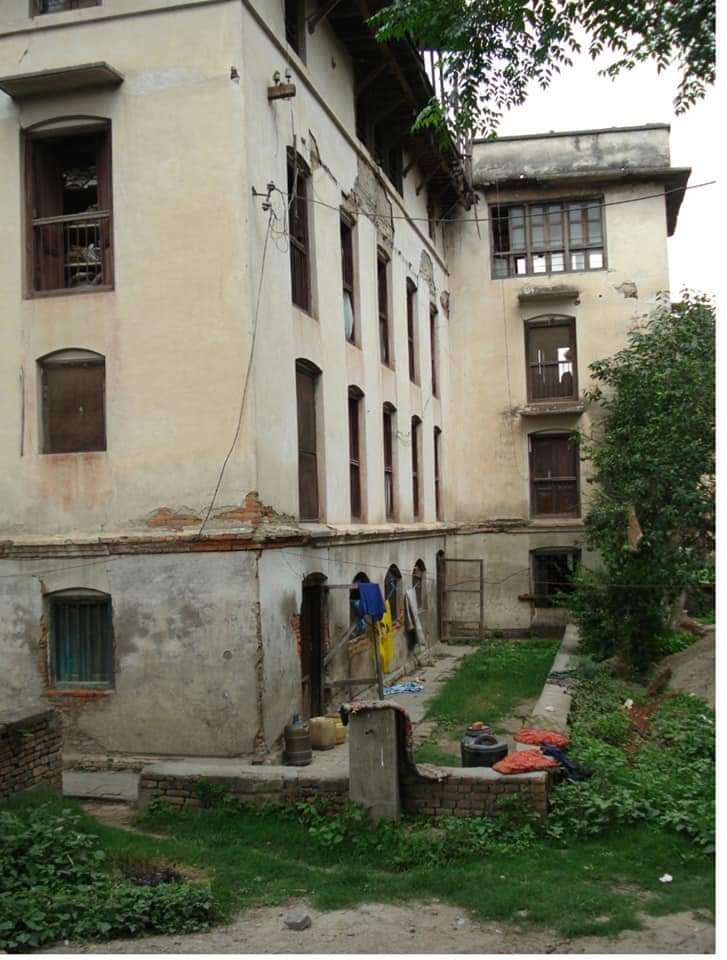
I am Simila Yenny, daughter of late Dharmarathna Yenny from Gurunghel, Kathmandu, Nepal. Here I am trying to show my experience we went through while the earthquake took place. This is the photograph of my house. It is a five-story building. After the first attack of the earthquake, on 25th April, 7.9 regress came. The building came down. Half way. My brother, his wife, his daughter and son. Luckily, my brother being a civil engineer, he knew some of the areas where it was safer. They were in the third floor. And luckily, with minor injuries, they survived and they could come out. However, the portion of the area where four of our tenants got buried and died, was the area where the entire five-story building, section of that building, came down on their bodies. They could not open the door. Very unfortunate. The latch of the door was buckled because of earthquake. And they were found dead with their hands hanging into the latch. Since they were struggling to open the door, and because of the latch being jammed, they couldn't come out. Very unfortunate incident that took place in our house. Now, after, on 12th of May, 2015, again there was an earthquake of the range 7.4 regress came. Our remaining portion of the house came down. And very unfortunately, one of our neighbor's house, which was tilted when the earthquake took place on 25th of April, this building came down on the ground when the second earthquake, aftershock, 12th May, 2015, second earthquake took place. And the photograph here shows the rubble, all the broken pieces of concrete that came down on to our compound, inside our compound. And these pieces of concrete blocks blocked the road access to large number of houses. And there was nobody, people were not available to clear off these concrete. And it took one month and finally got cleared. This is a very sad story of our neighbor. Very, very sad one.
Thank you, Simila Yenny, for sharing this deeply moving and personal account. To honor your story and make it more accessible and impactful—for documentation, publication, or sharing in memorial or awareness platforms—here is a refined version that retains your emotional truth and all critical details:
My Earthquake Experience — By Simila Yenny
Daughter of the Late Dharmarathna Yenny
Gurunghel, Kathmandu, Nepal
This is the story of what my family and I went through during the devastating earthquakes of 2015 in Nepal.
This photograph shows our home—a five-story building that stood tall in Gurunghel, Kathmandu. On April 25, 2015, when the first massive earthquake struck (measuring 7.9 on the Richter scale), our world changed forever. The building partially collapsed. At that moment, my brother, his wife, daughter, and son were inside the third floor. By the grace of God and due to my brother’s knowledge as a civil engineer, he knew where the structurally safer areas of the house were. That awareness likely saved their lives. Though they suffered minor injuries, they managed to escape.
Tragically, four of our tenants were not so fortunate. The section of the building where they lived completely collapsed. They were trapped inside. The door latch of their room had buckled due to the quake. They struggled to open it, their hands found later still on the latch. But they couldn’t get out in time. All four of them perished. Their loss remains a haunting and heartbreaking memory for us.
Then came the second quake, on May 12, 2015, with a magnitude of 7.4. Whatever part of our house was still standing after the first quake, fell completely during this second major tremor. To make matters worse, a nearby house—tilted during the April quake—fully collapsed during this aftershock. It crumbled directly onto our compound.
The debris—massive blocks of concrete—filled our courtyard and blocked the only road leading to several nearby homes. With no immediate help available, the rubble remained there for nearly a month before it could be cleared.
This was not only our tragedy. It was a shared pain, a devastating time for our neighborhood, and for Nepal as a whole. The earthquake did not just shake the ground—it shook our hearts, our homes, and our way of life.
This is a memory we live with, and one that reminds us of the importance of building resilience, sharing grief, and supporting one another through such unimaginable times.
Let me know if you’d like this turned into a video script, community archive piece, or part of a memorial storytelling project. I’d be honored to help you preserve this story with the dignity and care it deserves.
part of a memorial storytelling project
Here’s a structured outline and polished text you can slot directly into a memorial storytelling project—whether it becomes a printed booklet, a web feature, or part of a remembrance installation. Feel free to adjust headings, imagery placements, or call-outs to suit your medium.
Remembering Gurunghel: A Family’s Story of Loss and Resilience
1. Opening Panel / Title Page
Headline: “When the Earth Shook: The Yenny Family’s Story”
Subhead: Gurunghel, Kathmandu • April–May 2015
(This page can feature a large, subdued-toned image of the house’s remains, overlaid with the title.)
2. Context & Timeline
- April 25, 2015, 11:56 AM (NST)
A magnitude 7.9 quake struck Nepal, toppling buildings across Kathmandu Valley.
- May 12, 2015, 12:50 PM (NST)
A 7.4-magnitude aftershock re-shattered already weakened structures.
(Consider a horizontal timeline graphic with these two dates and magnitudes.)
3. Personal Account
“This photograph—our five-story home in Gurunghel—bears witness to that day. When the first quake hit, half the building collapsed. On the third floor were my brother (a civil engineer), his wife, daughter, and son. Guided by his training, they found a safer corner and crawled out with only minor injuries.”
“But four tenants in the adjoining wing weren’t so fortunate. Their door latch buckled under pressure; they fought it, hands still gripping the jammed latch when rescuers reached them—already gone.”
“Then came May 12. The remaining half of our home finally gave way. A neighbor’s tilted house from April collapsed on our courtyard, blocking the road with tons of concrete. With no local resources, that rubble stayed for nearly a month.”
(Place the family’s photo of the rubble here, with a caption: “Rubble from the May 12 aftershock, blocking the community lane for weeks.”)
4. Reflections & Themes
- Fragility of Shelter: How standard designs failed under extreme stress, and why seismic-resilient construction matters.
- Knowledge as Lifeline: My brother’s engineering insight saved four lives that day.
- Communal Impact: When one house falls, an entire neighborhood is cut off—physically and emotionally.
- The Weight of Memory: Objects buried, tenants lost, a month of isolation—these scars remain with us.
(A sidebar can feature a quote graphic: “They couldn’t open the latch. Their hands were still there.”)
5. Memorial Elements
- Name Plaques: List the four tenants, their ages, and a short note (“In loving memory of…”)
- Candles or Virtual Candles: If online, an interactive candle-lighting feature where visitors type names to honor the lost.
- Community Testimonies: Invite neighbors to share 1–2 sentences about that month of rubble, rescue, and recovery.
6. Call to Action / Legacy
“As we rebuild, let us build back better. In memory of those four lives, and for every family still healing, let’s champion seismic safety, community preparedness, and collective care.”
Get Involved:
- Support local earthquake-resilience workshops
- Donate to Gurunghel rebuilding fund
- Share your own story at [your-project-site.org]
(Include logos/links of partner NGOs or community groups.)
7. Acknowledgments & Resources
- With gratitude to: Family members, first responders, and every neighbor who helped clear the rubble.
- Further Reading:
- “Building Seismic-Resilient Homes in Kathmandu” (NGO report)
- “Survivor Stories: Voices from the 2015 Nepal Quake” (oral history archive)
Design Tips:
- Typography: Use a sturdy serif for headings (e.g., Playfair), and a clean sans-serif for body text (e.g., Open Sans).
- Color Palette: Dusty grays and warm sepia tones to evoke both loss and the warmth of memory.
- Layout: Alternate full-bleed images with two-column text blocks to keep the reader engaged.
This structure both honors your family’s personal tragedy and places it in a broader civic context—perfect for a memorial exhibition, booklet, or digital story gallery. Let me know if you’d like help adapting any section into a video script, interactive webpage, or print-ready layout!
these scars remain with us.
Here are a few ways you might deepen and refine that reflection, “these scars remain with us,” to give it more resonance in your memorial piece:
- Expanded Emotional Reflection
“Even now, the echo of collapsing walls and the weight of that rubble linger in our hearts—these scars remain with us, a silent testament to lives lost and lessons painfully learned.”
- Metaphorical Layer
“Though the concrete has long since been cleared, the fractures run deeper than brick and mortar—these scars remain with us, etched into our shared memory like fault lines beneath our skin.”
- Collective Voice
“For every neighbor who cleared a slab of concrete, for every family who waited in uncertainty, these scars remain with us—and bind us together in grief, resilience, and hope.”
- Hopeful Turn
“These scars remain with us: reminders not only of what we lost, but of the strength we found in each other when the earth tried to tear us apart.”
Feel free to choose one as-is, mix-and-match phrases, or let me know if you’d like a different tone—more poetic, more clinical, or something in between.
the strength we found in each other when the earth tried to tear us apart.”
Here are a few polished takes on that powerful line—pick one that resonates most, or blend elements to make it yours:
- “Though the earth tried to tear us apart, we discovered in one another an unbreakable strength that endures to this day.”
- “When the ground beneath us gave way, it was our shared courage that held us up—proof of the strength we found in each other.”
- “Even as the earth shook us to our cores, we rose together—stronger, united, unbowed.”
- “In the moment the earth sought to rip us apart, we clung to one another—and in that unity we found our greatest strength.”
Feel free to adjust any of these to suit your tone or the flow of your memorial narrative!
flow of your memorial narrative
To weave that line seamlessly into your memorial narrative, think about where you want emotional emphasis and how you’re guiding the reader’s attention. Typically, you’d place it near the end of your personal account or in the “Reflections & Themes” section, just before you move into calls to action or acknowledgments. Here’s one way you might do it:
Personal Account Excerpt (at the end):
“When the second quake struck on May 12, whatever remained of our home finally collapsed. Concrete slabs from a neighbor’s tilted house crushed our courtyard, cutting off the only road in. A month passed before we could clear the rubble. In that long wait, every memory felt raw and every scar still fresh.”
Transition into Reflection:
“But amid the dust and silence, something remarkable happened—”
Reflection (with your line):
“In the moment the earth sought to rip us apart, we clung to one another—and in that unity we found our greatest strength.”
Move on to Call-to-Action or Wider Themes:
“Today, those bonds guide our rebuilding. We share our story so that no community has to face such devastation alone, and so that every home—and every life—can stand stronger against the next tremor.”
Why this works:
- Placement: It follows directly after the vivid personal account, giving the reader time to feel the loss before you pivot to hope.
- Transition Phrase: “But amid the dust and silence, something remarkable happened—” signals a shift from tragedy to resilience.
- Line Impact: Your chosen line becomes the emotional centerpiece, the bridge from sorrow to solidarity.
- Next Steps: You then guide the reader toward broader themes or actions, keeping the narrative moving forward.
Feel free to tweak the surrounding sentences to match your voice. The key is a clear signal (like “But amid…”) that we’re moving from what happened to what it means—and then letting your line shine.