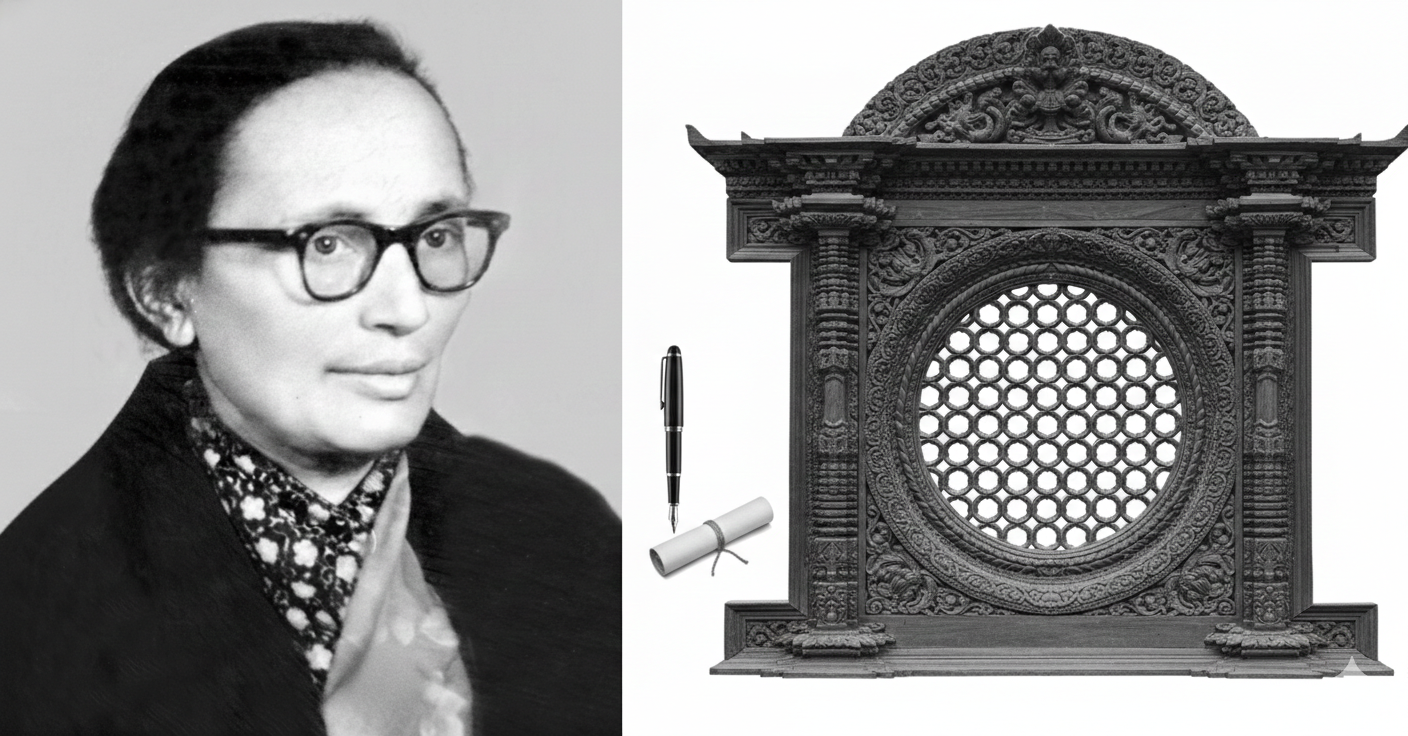
This article grows out of memory—personal, familial, and communal—and from the silences that surround women’s contributions to political and social change in Nepal. Heera Devi Yami is remembered in my family not only as a revolutionary who opposed the Rana regime, but as a mother and mentor who understood education as survival, resistance, and continuity. Through oral recollections and community histories, this article traces how her insistence on education, especially for girls, shaped lives and futures in a society where learning was systematically denied to most women.
Heera Devi Yami was deeply committed to expanding educational horizons within local communities. She engaged directly with families and guardians, patiently asking, persuading, and convincing them of the importance of education beyond conventional limits. At a time when awareness about higher education was minimal, most guardians expected their children—particularly their sons—to study only up to Class 10 and then pursue commerce-oriented pathways, which were seen as practical and sufficient.
Against this prevailing mindset, Heera Devi consistently advocated for science education, with a particular emphasis on STEM disciplines. Her efforts challenged entrenched assumptions about both the purpose of education and the intellectual capacities of young people from these communities. By encouraging families to consider science as a viable and valuable option, she worked to broaden aspirations that had long been constrained by limited exposure and economic insecurity.
Her work represented more than educational guidance; it was an intervention in social attitudes toward knowledge, opportunity, and future-making. Through sustained engagement at the community level, Heera Devi played a crucial role in opening pathways to scientific education that had previously been considered inaccessible or unnecessary. She had six daughters, and no girls from the community had ever pursued an engineering degree. Because of this, she was deeply committed to ensuring that her daughters went into the medical, technology and engineering stream, something that was completely unheard of at the time. She wanted to walk the talk so that other also followed. Traditionally, when girls grew up, they were adorned with jewellery, and the primary aim was to marry them off to economically secure families. This was the accepted goal for most mothers.
However, Heera Devi Yami never wanted her six daughters to follow that path of other mothers with limited awareness. She envisioned a different future for girls —one defined not by marriage alone, but by education, professional training, and independence.
In our community no girl had ever gone on to study technical and engineering field. Such degree academic programs were also not available then within the country. Because of that, she was very determined that her daughters should go into the STEM stream. She wanted something different for them. She believed that education and professional training were more important than ornaments and early marriage, and she held on to that belief even when it went against what everyone else expected.
In class 4 in my school Kanti Iswari Rajya Laxmi high school, Pyafal Kathmandu, there was a marriage from Manandhar community of Jhoche, Kathmandu, Basantapur area. And slowly, in higher classes, it is a girls' school and dropout of girls started taking place because they were married off. And girls around class 11 girls started talking about taking up arts courses if they are allowed to proceed with their higher education. Science, nobody talked about. Very rarely girls talked about it. Those who were in bureaucracy, the families from the royal family who served royal palaces, the parents had travelled abroad. They were exposed to the outer world. So very few people from such families only understood the importance of science. And some very selectively one or two girls actually opted for science courses, that also in biology. And in the mathematics area, nobody concentrated and I focused on mathematics.
My mother, Heera Devi Yami, wanted her children, especially her daughters, to become engineers, because there were no engineers in her community. When I was in Class 7 or Class 8, I clearly remember my mother telling me again and again to study mathematics and to do well in science subjects.
My father, however, imagined a different trajectory for me. He opposed my pursuit of higher education and repeatedly asserted that I should become a newsreader at Radio Nepal, a role he believed he could train me for directly. In a period marked by heavy media censorship, this aspiration reflected his own political frustrations and his belief in broadcasting as a site of influence and resistance.
He incorporated me into this vision through daily practice. Draft materials from the manual printing press were sent to our home for correction, and I was responsible for proofreading punctuation and structure in Nepali. This labor functioned as an informal apprenticeship, through which he attempted to steer my future toward media work rather than formal academic advancement.
My mother’s mentoring was especially visible at the point of transition—from a girls’ school environment to a co-educational academic setting in Classes 11 and 12 at ASCOL. Until Class Ten, schooling took place within a protected, gender-segregated space. Movement was regulated, friendships were closely monitored, and girls were expected to remain within clearly defined social boundaries.
My mother understood that co-education would demand a different kind of preparedness. Rather than reinforcing fear or restriction, she focused on equipping me with confidence, clarity, and purpose. She would ask me directly whether I spoke to boys in college. When I answered no, she did not approve of my silence. Instead, she encouraged me to speak—to discuss studies, career plans, and future goals. For her, interaction was not a moral risk but a necessary part of intellectual and professional development.
This advice sharply contrasted with the guidance given to my peers. Most mothers warned their daughters never to speak to boys, insisting that they remain only among girls. My mother’s position was unusual and, at the time, deeply unsettling to others. Yet for her, education was not confined to textbooks. It included learning how to exist, speak, and think within mixed public spaces that women would inevitably have to enter if they were to become professionals.
In this way, my transition into a co-educational environment was not accidental. It was mentored. It was deliberate. My mother treated co-education as preparation for public life, not as a threat to respectability. This form of everyday guidance—quiet, persistent, and grounded in trust—was part of how she reproduced political strength and autonomy across generations, even as her own health was failing.
This account is based on personal recollection and repeated family conversations during my adolescence, later reflected upon in light of my educational trajectory.
I do recall my father often complaining to my mother about my choices. He was so keen that I should get employed at Radio Nepal at a very young age, with the ultimate goal that I would become a newsreader there. My father, who was a revolutionary figure, had once wished to capture the Radio Nepal broadcasting station because, at that time, news was heavily censored. I think he was very frustrated with the system, and he hoped that I would follow a career path in broadcasting and take up that challenge in my own way.
I do remember my mother, had serious heart problems. She often collapsed or suffered blackouts while walking on the road. Our family never had any transport, so she had to walk everywhere. Her heart was swollen, and there were no medical doctors available to care for her condition. She also suffered from acute asthma. I remember often taking her to hospitals. She was always falling ill, always in some kind of health crisis.
The health assistant, Chandraman, compounder from Chhatrapati, would often scold her, saying, “You will die on the road. Don’t take such heavy stress from the family.” She carried the financial burden, the responsibility of a strong and often angry husband who would shout and lecture about the failures of the government. My father, Darma Ratna Yami, had no time for the family, no time to care for her health. Her days were clearly numbered.
Everyone around her used to say, “Get your daughters married off. At least that burden will be lifted. You are going to die any day. If the girls are married, they will at least be settled.” There were marriage proposals at very young ages, as the community always followed arranged marriages early. Boys often dropped out of school as well. Fathers running shops or businesses expected their sons to take over responsibilities—handling supplies, collecting money, managing daily operations. Education was rarely a priority for fathers or sons. Dropouts were common in these communities.
Girls, once grown even slightly, were expected to marry. Families preferred young brides, usually younger than the boys. Education for girls was never prioritized; early marriage was the rule.
Under such circumstances, Heera Devi Yami, even as her health declined and her life was short, openly opposed early marriage. She would tell everyone, “If I die, don’t worry. My daughters will continue their education, and when they are fully educated, they will choose partners of their own choice.” Her words shocked the family, the relatives, friends, and society. Inter-caste marriage was banned. Love marriage was considered a criminal act. Yet the bold, dying Heera Devi continued to instill this belief in her daughters with courage and determination.
Ratnadas Tuladhar, my father Dharma Ratna Yami's grandfather, suffered huge financial losses because of the loot policy under ruler Chandra Shumsher. He had four sons and three daughters, and the family went through very hard times. Ratna Das tried to start a small shoe-making business, but even in that venture he faced financial damage.
As a result, the four sons went in different directions. One son went to Bangalore to work. The elder son, Asaratna Tuladhar, went to Butwal to open a shop. Bhawani Ratna Tuladhar went to Tibet for trade. And Mandas Tuladhar took on the responsibility of recovering the family losses and repaying the loans. Ratnadas Tuladhar became very ill due to the financial strain and eventually died.
With all the sons out of Kathmandu and the heavy burden of suffering, the family began to see things differently. While they were in Calcutta, Kalimpong, Darjeeling, and Sikkim, they traveled widely and observed what was lacking in Kathmandu. Their outlook became very different from the rest of the society, which was largely suppressed, dominated by fear, steeped in religion and rituals, and kept away from politics. Most families stayed within the community, scared, and never interacted with the outside world.
The four sons of Ratna Das, having had this outside exposure, came to understand the importance of education. When they all eventually returned to Kathmandu, they brought back different views about educating children—views that were far more open and forward-looking than the prevailing mindset in the local society.
The maternal side of Heera Devi Yami came from a business-class family—the Lasa traders—considered wealthy and well-off in the community. The family strictly followed traditional rules and social norms, and the children grew up with very traditional thinking.
It was Heera Devi Yami who often intervened, mentoring the family and encouraging them to send children for education. Despite her efforts, the broader maternal-side family—her grandfather’s four sons and their households—remained focused on traditional rituals, especially getting children married at a very early age.
When Heera Devi Yami became ill and her health grew fragile, the “mini mothers” of her maternal side became very worried about her six daughters. When Heera Devi passed away at the age of 49 in 1970, these relatives were even more concerned about the future of her daughters. They would often talk about getting the girls married off quickly, worried that if they waited too long, the daughters might be “spoiled.”
Very often, whatever Dharma Ratna Yami wrote was banned from publication. There was heavy censorship in the newspapers and print media, and I think he was frustrated. Perhaps he wanted his daughters to stay away from the media world.
But the brave Heera Devi Yami, who had fought to overthrow the Rana regime and even gone to jail under such a conservative society, had a different vision. She understood that all her seven children should carry forward the revolutionary spirit and continue her legacy. Even as she was dying, she wanted her children to take leadership and contribute to the country.
She would often advise other families to encourage their children to pursue science, engineering, medicine, and other professional fields. She believed that education in these areas would make children mentally strong, financially independent, and capable of fighting for good governance in Nepal. I clearly remember her saying that all her seven children should take up technology and science, because she wanted these fields to be the backbone of the country’s development.
.
In those days, families who worked for the palace or served in the bureaucracy were seen as very powerful. They lived differently from the rest of us, often apart from the wider community. For ordinary people, there were very few choices. Censorship was everywhere, and it was understood that the government wanted to keep the general public economically weak. Anyone who appeared to be doing well risked being noticed, and being noticed was dangerous. People lived with fear. Families connected to Heera Devi Yami and Dharmaratna Yami—such as the Tuladhars, the Kangsakars, and others whose ancestors had once traded along the Silk Road—were watched more closely than most. The rulers did not want these communities to regain wealth or influence. Many people went out to places like Calcutta, Kalimpong, Darjeeling, Sikkim, and Tibet to work or trade, and then returned. But whatever they earned had to remain hidden. Prosperity could not be shown. Everything had to be kept quiet—very quiet.
A survey conducted in 2025 among elderly senior citizens from the communities connected to Heera Devi Yami and Dharma Ratna Yami—including extended family networks and local communities in the core areas of the Kathmandu Valley—reveals a stark historical pattern. Nearly 95 percent of the elderly population surveyed had received no formal education. The small minority who were educated—approximately five percent—largely came from families that served the royal palace or were employed within the state bureaucracy. In their time, girls and women from these elite households were often married at an early age; however, they continued to receive education at home and, in some cases, pursued further studies even after marriage. For the vast majority of the population, particularly women from ordinary families, access to education remained severely restricted. Until 1951, formal education for the general public was effectively prohibited, leaving generations of women excluded from institutional learning and reinforcing the deep structural inequalities that shaped their lives. It was within this landscape of widespread educational exclusion that Heera Devi Yami’s insistence on education—especially for girls—emerged not as an individual choice, but as a radical and enduring intervention against structural inequality.