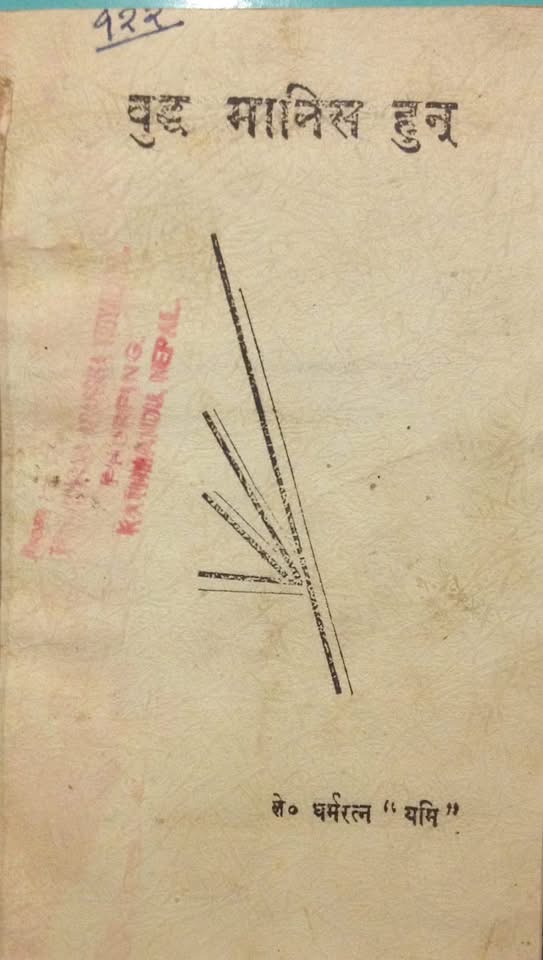
The historical legacy of Dharma Ratna Yami is the story of an intellectual time-traveler. In his own era, he was a profoundly radical and often isolated figure. The friction between his philosophy of the “Human Buddha” and the prevailing socio-political environment of Nepal was not merely a religious disagreement; it represented a fundamental cultural and structural conflict.
As contemporary intellectual Janak Raj Sharma once observed, the “great people of India understood” Yami—a reference to the transnational bridge he built during a period of regional awakening. India was undergoing a major Buddhist revival led by figures such as B. R. Ambedkar and Rahul Sankrityayan. These thinkers viewed the Buddha not as a distant deity to be appeased through ritual, but as a revolutionary advocate of social equality. Yami was their contemporary and ideological counterpart, working across the border to challenge inherited hierarchies.
The Geography of Misunderstanding: Nepal vs. India
To understand why Yami’s ideas were suppressed at home yet appreciated abroad, one must examine the differing environments of mid-century South Asia.
In Nepal, orthodox religious rituals were deeply intertwined with the authoritarian Rana regime. Within such a society, emphasizing the Buddha as a historical and human figure was politically subversive. If the Buddha was understood as a man guided by logic, empirical observation, and justice, then every individual possessed the inherent right to question corrupt authority. To the traditional elite, this was heresy; to Indian reformers, it was a blueprint for a democratic future.
Yami famously embodied his philosophy through action. His radical decision to hire a cook from a marginalized, so-called “untouchable” caste and invite Kathmandu’s elite to a feast served by her became a direct and practical expression of Buddhist humanism. While local conservatives reacted with outrage, Indian intellectuals engaged in parallel struggles against caste discrimination recognized him as a visionary.
Where many of his contemporaries focused on accumulating metaphysical “merit” through ritual performance, Yami redefined merit in terms of intellectual awakening and social justice. For him, peace did not descend from an external divine force; it emerged through the transformation of human consciousness and society itself.
During his lifetime, his writings were banned, and he faced persistent state marginalization. Yet this suppression ultimately demonstrated the disruptive power of his ideas. He challenged a ritual-dominated status quo that society was not yet prepared to confront. His core distinction between inner transformation and divine birth remains one of his most enduring philosophical contributions.
The AI Convergence: Why the “Maha Manushya” Resonates with Youth Culture
Decades after his death, global interest in “Secular Buddhism” and “Engaged Buddhism” has finally converged with many of Yami’s foundational ideas. Remarkably, his radical humanism appears especially relevant in the age of Artificial Intelligence. Younger generations, increasingly skeptical of rigid institutional dogma, are discovering that his vision of the Human Buddha aligns closely with a data-driven and psychologically informed worldview.
This resurgence is rooted in three important parallels between Yami’s thought and the modern technological landscape:
1. The Algorithmic Nature of Karma
Young people today often understand the world through systems, logic, and feedback loops. Yami’s interpretation of karma as a law of cause and effect—rather than divine reward or punishment—resonates strongly with a generation accustomed to thinking in terms of inputs and outputs. Rather than searching for a heavenly judge, they seek to understand the underlying “source code” of human suffering and how it may be transformed.
2. Intellectual Autonomy in the Information Age
In an era of decentralized information, traditional gatekeepers of knowledge are rapidly losing authority. Yami’s lifelong emphasis on self-education as a form of resistance has become deeply relevant to Millennials and Gen Z. These generations often prioritize direct, verifiable experience over inherited belief systems that constrained earlier societies.
3. The Human Being as a Dynamic Process
The rise of AI continually raises the question: what truly makes us human? Yami’s concept of the Maha Manushya (“Great Human”) proposes that humanity is not a fixed condition determined by birth or caste, but an evolving potential that must be consciously cultivated. This idea parallels contemporary discussions surrounding neuroplasticity, identity, and the fluid nature of the self in the digital age.
From History to Living Manifesto: Modern Engagement in Nepal
In contemporary Nepal, Yami’s philosophy has moved beyond historical memory to become a living framework for modern social and intellectual movements. His influence can be seen across several interconnected fronts:
- Rejecting the deification of the Buddha and emphasizing his humanity.
- Adopting the surname “Yami” as a symbolic rejection of caste identity.
- Advocating for a secular state in which dignity is grounded in civic responsibility and intellect rather than divine sanction.
- Supporting parliamentary efforts to dismantle caste-based discrimination and publicly challenging untouchability.
- Inspiring youth-led initiatives that draw upon his speeches and writings to create indigenous models of inclusion and social equity.
- Promoting self-directed education as a powerful tool against political and cultural suppression.
- Encouraging crowdsourced digital archiving, the circulation of out-of-print texts through open-source PDFs, and the use of social media as platforms for independent thought and public discourse.
By removing the requirement of “divine birth” from the pursuit of greatness, Dharma Ratna Yami democratized human potential. He left future generations with a message that remains urgently relevant: one does not need to be born into privilege to achieve personal or social transformation; one needs only the courage to think critically and act ethically.
Ultimately, the digital bridges being built today through archival preservation and online discourse ensure that his legacy is no longer confined to the past. Dharma Ratna Yami was not writing solely for his contemporaries—he was articulating a manifesto for the future. A new generation is finally prepared to hear it.