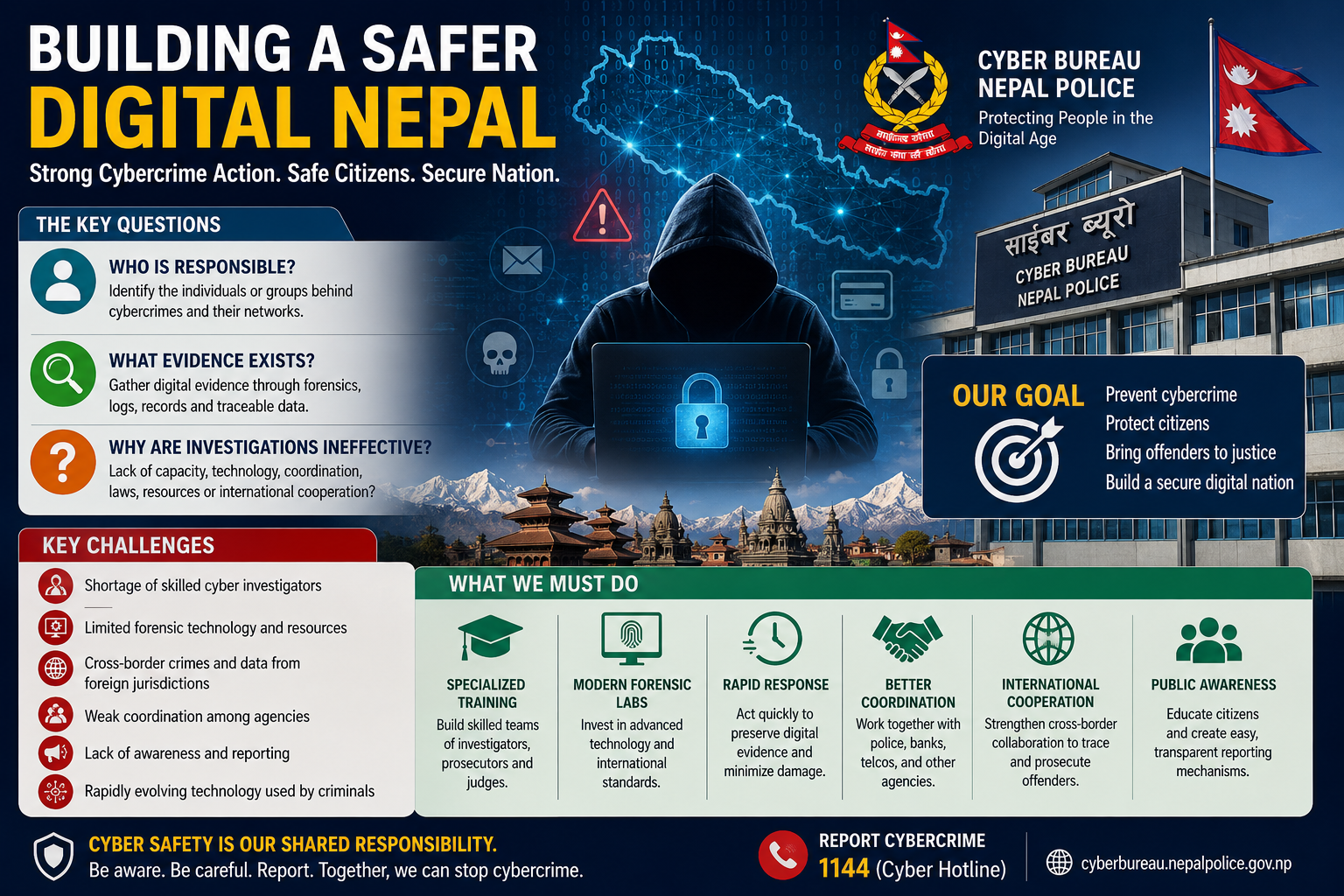
The rapid expansion of digital technology has brought enormous benefits to Nepal, but it has also created new opportunities for cybercrime, online fraud, hacking, identity theft, harassment, misinformation, financial crime, and other forms of digital abuse. As more citizens, businesses, government institutions, and financial services move online, cybersecurity has become a matter of national importance.
Nepal Police’s Cyber Bureau has an important responsibility to investigate cybercrime and protect citizens from digital threats. However, the growing number and sophistication of cyber incidents raises a serious question: Is Nepal’s existing cybercrime system sufficiently equipped to protect the public and respond effectively?
The issue should not simply be about blaming one department. We need to examine the entire system—from reporting and investigation to digital forensics, prosecution and international cooperation.
Everyday Religiosity vs. Performative Devotion:
In traditional societies like the Kathmandu Valley, heavy spending on stone rituals, lavish pujas, rare gemstones, and public worship often slides from genuine faith into performative display.
The Social Shield:
Sociological surveys reveal that communities readily trade social status and trust for public piety. Bad actors—ranging from corrupt officials to predatory figures—exploit this dynamic, using grand cultural participation as a cover to deflect scrutiny from their private and financial misconduct.
The Modern Weaponization:
A dangerous shift occurs when high social standing and deep financial reserves merge with accessible digital tools. Fraudsters use this combination not only to build bulletproof pious personas, but also to execute character assassination and modern financial scams.
When bad actors leverage public piety or social standing as a shield, they often use their capital to wage subtle, high-impact campaigns against those who challenge them. Synthetic media—such as deepfakes, manipulated audio, and generated imagery—has drastically lowered the cost of orchestrating these attacks.
When wealth and performative status are paired with sophisticated technical tools, protecting genuine public servants and honest leaders requires robust legal protections, advanced digital forensic infrastructure, and heightened public vigilance.
Who is responsible?
The first question in any serious cybercrime case should be: Who is responsible?
Cybercriminals may operate individually, through organized groups, or from outside Nepal. Some crimes may involve networks that use multiple countries, anonymous accounts, fraudulent identities, cryptocurrency, encrypted communication, or compromised devices.
Therefore, investigators need the technical capacity to establish who actually carried out an offence and whether there was any organized coordination behind it.
What evidence exists?
The second question is: What concrete evidence exists?
Cybercrime investigations must be based on evidence such as digital records, server logs, transaction records, device analysis, IP information, communications, metadata, financial trails, and other forms of digital forensics.
Accusations alone are not sufficient. Nor should people be labelled criminals merely because of their political views, nationality, ideology, or association with a particular group.
The strength of a cybercrime investigation ultimately depends on the quality of the evidence and the ability of investigators to preserve, analyse and present that evidence properly.
Why are investigations sometimes ineffective?
Another important question is why existing mechanisms may struggle to identify, investigate and prosecute cybercriminals efficiently.